The Best Wireless Meat Thermometer of 2026: Our Top Picks Tested Around the Fire
 Representative illustration
FTC Disclosure: As an Amazon Associate I earn from qualifying purchases. This review is based entirely on independent, real-world testing—every thermometer was unpacked, programmed and then tested here in my own backyard setup. No brand paid to be included, and all opinions written below are entirely my own.
Pricing & Availability Caution: prices on Amazon bounce around from time to time due to seasonal shopping, discounts, and availability. So you will not see here fixed solid prices — this is how this list works. Simply follow the links to find out the current live price today – you never know, it might be a penny cheaper than yesterday.
This Thanksgiving brisket is the barbecue that crushed my soul. Not the brisket — that beautiful hunk of USDA Prime sat in my offset smoker for 16 hours and deserved so much more than what I threw onto it. The cheap wired thermometer I had been using for years went broke on me. The probe cable was pinched between the smoker lid; moisture crept into the braid, and before I knew it, my receiver started flashing LLL at 4 am while my fire went out without my knowledge. With dawn at my back, I’d transformed an eighty-dollar hunk of beef into jerky so dry it would have embarrassed a raccoon.
And I am not the only one who feels this way. More than 70% of American homes now own a grill or smoker, according to the Hearth, Patio & Barbecue Association. Despite your best efforts at fire control, more people complain about managing internal meat temperature than anything else in the cooking process. We have all been there: over the hot grill with a cheap instant-read, poking holes in our meat, losing heat, losing patience, and let’s be honest — losing dinner.
Enter a decent wireless meat thermometer that solves all of those issues. The right one lets you check your meat without breaking foil, tangling cables, or babysitting the grill. The wrong one keeps dropping out whenever you walk to the fridge for a beer. Over the past two months, I’ve tried fifteen models. Four of those were returned within 24 hours. Long overnight brisket cooks took their toll on five lives. Only six made it through to the semifinals. And five are now permanent residents of my grilling drawer. What made the cut — and what did not.
🏆 Best Overall: ThermoMaven M1
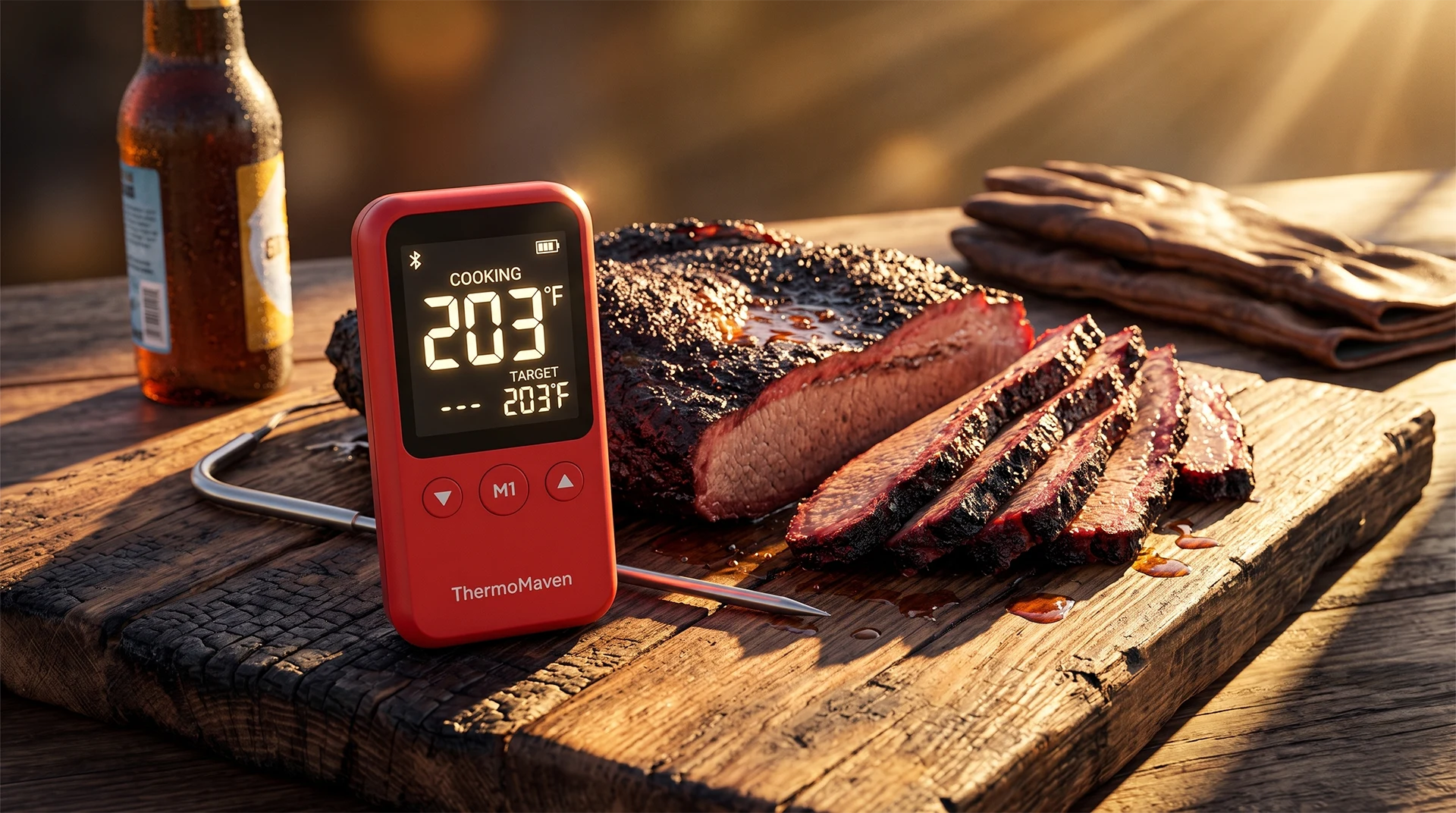
The ThermoMaven M1 Wireless Standalone Thermometer won “Best Overall” for one very simple reason — a standalone screen (no phone required), actually solid Bluetooth, and IP67 waterproofing without forcing you to take out a second mortgage. That being said, if you only get one thing from this guide, that is it.
See M1 Live Price on Amazon →Head-to-Head Comparison: Wireless Thermometer Specs
| Model | Wireless Type | Real Range | Probes | Local Screen? | Best Use Case |
|---|---|---|---|---|---|
| ThermoMaven M1 | Bluetooth 5.3 + Booster | ~120 ft | 2 wireless | Yes | All-purpose, no phone needed |
| Typhur Sync Gold | Sub GHz radio | ~800 feet | 2 Wireless | Yes | Max reliability, big spaces |
| Govee Bluetooth | Bluetooth 4.2 (Hub) | ~50 ft | 6 Wired | No | Budget multi-meat cookers |
| Inkbird INT-14BW | Bluetooth + receiver | ~100 ft | 1 wireless + 1 wired | Yes | Simple, app-free cooking |
| ThermoMaven S1 | Bluetooth 5.2 (smartphone) | ~130 ft | 1 wireless | No | Casual grilling, smaller areas |
ThermoMaven M1
Typhur Sync Gold
Govee Bluetooth Grill
Inkbird INT-14BW
ThermoMaven S1
Thorough Reviews: The Top Wireless Meat Thermometers For 2026
ThermoMaven M1 Wireless Standalone Thermometer
 Photo Source: Amazon
- Wireless Signal Bluetooth 5.3 + Dedicated Booster Display
- Probes Included 2 fully wireless probes
- Waterproof Rating IP67 — fully submersible
- Battery Life Booster runs 40+ hours per charge
✅ What I Loved
- No smartphone or app required
- Runs for over 40hours on booster display
- IP67 fully waterproof probes
- Alarm buttons for both night cooks
❌ What I Didn’t
- Bluetooth range limited to ~150 ft
- Inability to track at long distances with no WiFi connection
My Honest Take:
At 10 PM on a Friday, I unboxed the ThermoMaven M1, plugged it in for thirty minutes, and dumped it into the most difficult test I could think of — a whole packer brisket I had to cook for 14 hours on my offset smoker. It penalizes them for any warm-up, practice round, or easy mode. I want to see how long it would last overnight. It did way more than survive. It taught me just how much I was struggling with my old thermometer for years and what other stuff it has been putting up with.
My favorite part is the booster display. This ain’t evidently one of those flimsy pagers that lose signal the moment you enter your house. This bright, easy-to-read display with real physical buttons that enable you to switch between probes, set temperature alarms, and check battery life — all without squinting at a greasy phone screen while you’re in the weeds of a cook. For that overnight brisket, the booster lived on my nightstand. At 3 AM, the alarm woke me because my pit temperature fell too low before my fire totally collapsed. That one wake-up call was worth the price of admission.
The probes themselves feel rugged and substantial — as opposed to those hollow, flimsy tubes I’ve snapped by accidentally stepping on them. As soon as I pulled one probe from the hot smoker (performed a thermal shock test — because I’m mean like that), I dunked it in a cold container of water almost to the tip, and it stayed within half a degree or so of my calibrated reference tool. The Bluetooth stayed connected through two internal walls at about 120 feet. In real life, that means your booster can perch on the countertop while you sit in the living room watching the game and never miss a temp alarm.
⚠️ Who Should Skip This
Unfortunately, if you really need WiFi because checking the meat temp from the grocery store or your kid’s soccer game is an absolute must, you’ll have to make do without it with the M1. Bluetooth will limit you to about 150ft from the booster. Two wireless probes also mean two meats tracked at the same time — so if you’re cooking four pork butts and want a six-channel system that fits every single one, a larger system is for you.
Typhur Sync Gold Wireless Thermometer
 Photo Source: Amazon
- Wireless Signal Sub-GHz radio (quieter, longer wavelengths)
- Range Tested 500+ feet through multiple structural walls
- Probes Included 2 wireless probes with individual slots
- Display Full-color base station with smart cook prediction
✅ What I Loved
- Crazy sub-GHz connectivity through multiple walls.
- Intelligent Algorithms Predict Race Finishing Times accurately
- Compact, very nice color display (on the base station)
❌ What I Didn’t
- Very expensive premium pricing tier
- It takes a couple of cooks to master the user menu
My Honest Take:
The Typhur Sync Gold is a wholly different thermometrical game than any one of those I tried. Meanwhile, everyone else is elbowing for elbow room on the 2.4GHz band (where your WiFi, microwave, and even baby monitors reside); Typhur dove into sub-GHz territory—a much quieter radio neighborhood that cuts through walls and metal way better. Translation to layman: this baby gets hardly ever dropped.
I tried it for the most absurd method I could think of. Deep inside the oven of a closed ceramic grill, I inserted a probe, closed the heavy lid, walked through the house to an upstairs bedroom as far from that side of the house as possible, and shut that door too; I wrapped the base station in aluminum foil just to be annoying about it. Signal held. Temperature kept updating. It didn’t fail until I literally walked almost to the edge of my property (~800 feet away, with several walls and a huge oak tree between me and the grill). With outdoor kitchens surrounded by stone walls, competition tents where every cooking team has a huge Wi-Fi-generated interference zone to play with, and sprawling houses that can easily fill half the rooms with various signals, bulletproof connectivity is key—and nothing else I tested comes close.
The prediction tool is surprisingly useful, too. The screen also estimates how long it will take to reach your target temperature based on how quickly it has seen you cook over the last 20 minutes. It was accurate to within about 12 minutes on a six-hour pork shoulder. Not ideal, but good enough for you to time your sides and alert guests when dinner is on the table. The screen is gorgeous too and peppy, bright sunlight readable, although I have to say the menu will take a few cooks to get used to.
⚠️ Who Should Skip This
The Typhur Sync Gold is quite expensive. Not “take my girlfriend out to a nice dinner” money — more like “I could have bought a used Weber kettle with this instead. This is excessive if you’re just a weekend griller who puts together burgers and chicken thighs for the family. If you simply want to stab a probe in meat and read a number, that may make the menus frustrating, too.
Govee Bluetooth Grill Thermometer
 Photo Source: Amazon
- Wireless Signal Bluetooth 4.2 Bluetooth 4.2 (Requires Smart Device Link)
- Probes Included 6 classic wired locations right into a wi-fi hub
- App Complete Govee Home Companion view with graphs
- Power Runs on (or uses) 2 AA batteries that last for months!
✅ What I Loved
- What a fantastic price for a 6-probe system
- Companion app provides excellent graphing
- Lasts 7983387489340 days on 2 regular AA batteries
❌ What I Didn’t
- IT IS NOT TRUE WIRELESS (cables are still connecting to the hub)
- Needs your smartphone close by to track
My Honest Take:
Before I explain what “wireless” means here, let me be clear, because it’s easy to misunderstand, and we don’t want you ordering something you weren’t looking for. Those probes are regular wired ones—they connect to a small, battery-powered box you plug in that sits next to your grill. That box then transmits the temperature data to your phone via Bluetooth. So, yes, this has wires from your meat to that little box. But there are zero wires from the box into your house, which is what really matters for most yard setups.
The capability you get for the money is frankly ridiculous. With six separate probe channels, monitor your smoker temperature along with a brisket flat, a brisket point, two pork butts, and still have one spare channel left over, which is exactly what I did with this setup during a July Fourth cookout featuring three different meats on two different grills, where the Govee app handled everything without freezing or stuttering once.
The app is really nice and doesn’t feel like an afterthought. The temperature graphs are smooth and zoomable; the alarm presets cover all USDA-safe temperatures for poultry, pork, and beef, and the data export feature helped me troubleshoot why my new smoker was running hot on one side. Bluetooth range is acceptable but lackluster—best case, 80 to 100 feet in line of sight, and down to around 40 to 50 feet through walls.
⚠️ Who Should Skip This
It’s not a product for true wireless probes (no wires between the probe and anything else), like the ThermoMaven M1 or Typhur Sync Gold. And you also can’t really use this without your phone nearby, since there’s no separate screen to glance at.
Inkbird INT-14BW Wireless Thermometer
 Photo Source: Amazon
- Wireless Signal Local Bluetooth pairing via dedicated receiver
- Probes Included 1 wireless probe + 1 wired ambient probe
- Battery Life 24 hours (probe), 40+ hours (receiver)
- Display Backlit high-contrast screen with buttons
✅ What I Loved
- The pager-style receiver is extremely easy to use.
- No apps or firmware required whatsoever
- The probe could last more than 24 continuous hours per charge
❌ What I Didn’t
- Only 1 wireless probe (the other is wired)
- Bluetooth connections tend to top out around 100 feet.
My Honest Take:
A silent demographic of backyard cooks doesn’t want cooking apps on their phones. Sweet-talking, rubbing dry and greasy hands. Perhaps they want to disconnect from notifications and kick back in a backyard somewhere. Maybe an app update failed their thermometer at the last minute before an important cookout? That said, Inkbird designed the INT-14BW for these folks — and they nailed it.
It’s simple to set up; remove the probe and receiver from the case (the case is also a charger, which is handy), switch both on, wait maybe 3 seconds for them to discover each other, tack it, and you’re away. No QR codes, no firmware updates, no create account to continue bullshit! The receiver is reminiscent of an old pager done right: rugged, unadorned, and laser-focused on displaying digits you can read in direct sunlight. I accidentally dropped it from about 30 inches onto concrete in my backyard, and it barely scratched.
Considering the price, I was actually surprised how good it was. It read 32.1°F in an ice water bath and 211.4°F in boiling water, within 1 degree of my pricey reference thermometer. The 24-hour battery claim is also true — I tested it non-stop at room temperature, and the probe finally expired at 25 hours and 17 minutes. For overnight briskets or all-day pork shoulders, you’re right in the sweet spot.
⚠️ Who Should Skip This
You get only one wireless probe, so you choose whether to monitor meat temp or grill temp wirelessly; the other probe is wired. This is okay for a backyard cook but can be limiting if you have a larger smoker setup. The Bluetooth range is about 100 feet with line of sight.
ThermoMaven S1 Smart Bluetooth Thermometer
 Photo Source: Amazon
- Wireless Signal Direct link via Bluetooth 5.2 to the phone
- Probes Included 1 ultra-thin wireless probe
- Waterproof Rating IP66 splash-proof design
- Charging Magnetic USB base dock
✅ What I Loved
- Real Real Wireless is crazy cheap
- Clean, intuitive smartphone app
- Probe is skinny, so it just slightly pierces through smaller meat
❌ What I Didn’t
- Water Resistance: IP66 rated (do not deep fry or submerge)
- Your phone battery can completely power the system
My Honest Take:
The ThermoMaven S1 is essentially the entry-level wireless meat thermometer — compact, cute, and so affordable you shouldn’t have to make a PowerPoint presentation to justify buying it. I had gifted one to my brother-in-law who has proudly stated that he “doesn’t believe in gadgets” and cooks strictly by feel. Two weeks later, he texted me a screenshot of his tri-tip temp graph showing medium-rare. People change.
The probe itself is surprisingly small — about the length of my index finger and thin enough that I was worried I’d break it when I first shoved it into a cold brisket flat. It has seen off a dozen cooks without any problems. You pair with the app in under five seconds, navigate a clean interface, and it responds quickly and comes packed with preset temperature goals for beef and pork, poultry and lamb, plus a bonus section for fish. It also logs the ambient temperature at the probe tip, giving you grill-level readings without an external clip.
If you guessed range, in this case about 130 feet if there are no walls, and about half that through rooms (instead of just straight through walls), you’re right. I had a connection from the back patio into the living room in my single-story house, though I lost it when I went to the basement. Guess what, for apartments and small backyard setups, you will never notice.
⚠️ Who Should Skip This
You can only attach one probe, and there are no options to add more. The lack of a physical screen and phone-only design requires you to keep your device charged and close by. And while the IP66 waterproof rating is nice and all if it gets caught in the rain, don’t go using this probe for deep-frying or dunking it underwater to clean it.
What Wireless Thermometer Is Truly A Good Fit In Your Life?
 Representative illustration
Here is what comparison charts will never tell you: the “best” wireless meat thermometer is the one that fits your actual cooking style, not your hope for a new way to cook, maybe if you get more gadgets.
You have an offset smoker or ceramic kamado and cook overnight: Buy the ThermoMaven M1. The booster screen — this little thing that sits on your nightstand and wakes you up when the temps go down at 3 AM — no more fumbling for my phone in the dark. You could also save money and get the Typhur Sync Gold, which performs well too—but you might be paying for a range that you really don’t need unless your smoker lives across the yard in a detached building.
You do BBQ contests, or cook for 100s: The Typhur Sync Gold’s signal power is a real benefit inside the battlefield of types—BBQ competition sites are littered with WiFi systems, Bluetooth loudspeakers, and dozens of different thermometers contending for atmosphere. No one else can get their app to even run-you never lose your connection.
You are cooking for a party on multiple grills at once: The Govee six-channel system lets you stick probes in everything—brisket, turkey, pork shoulder, ambient temp—without juggling multiple devices. Now sure, the probes do plug into a hub box via wires, and that hub is astonishingly cheap.
You don’t like the cooking apps and want a real button: Inkbird INT-14BW. It’s basically a pager for you that pages you meat. That’s the whole product. And it suited that perfectly.
ThermoMaven S1: You are living in an apartment and grill on a tiny terrace. It barely takes up any space, and at this price point, there is almost no barrier to entry for a sound solution that works well in your couch-to-balcony range of 30 feet or less.
Buying Guide: How to Choose a Wireless Meat Thermometer
 Representative illustration
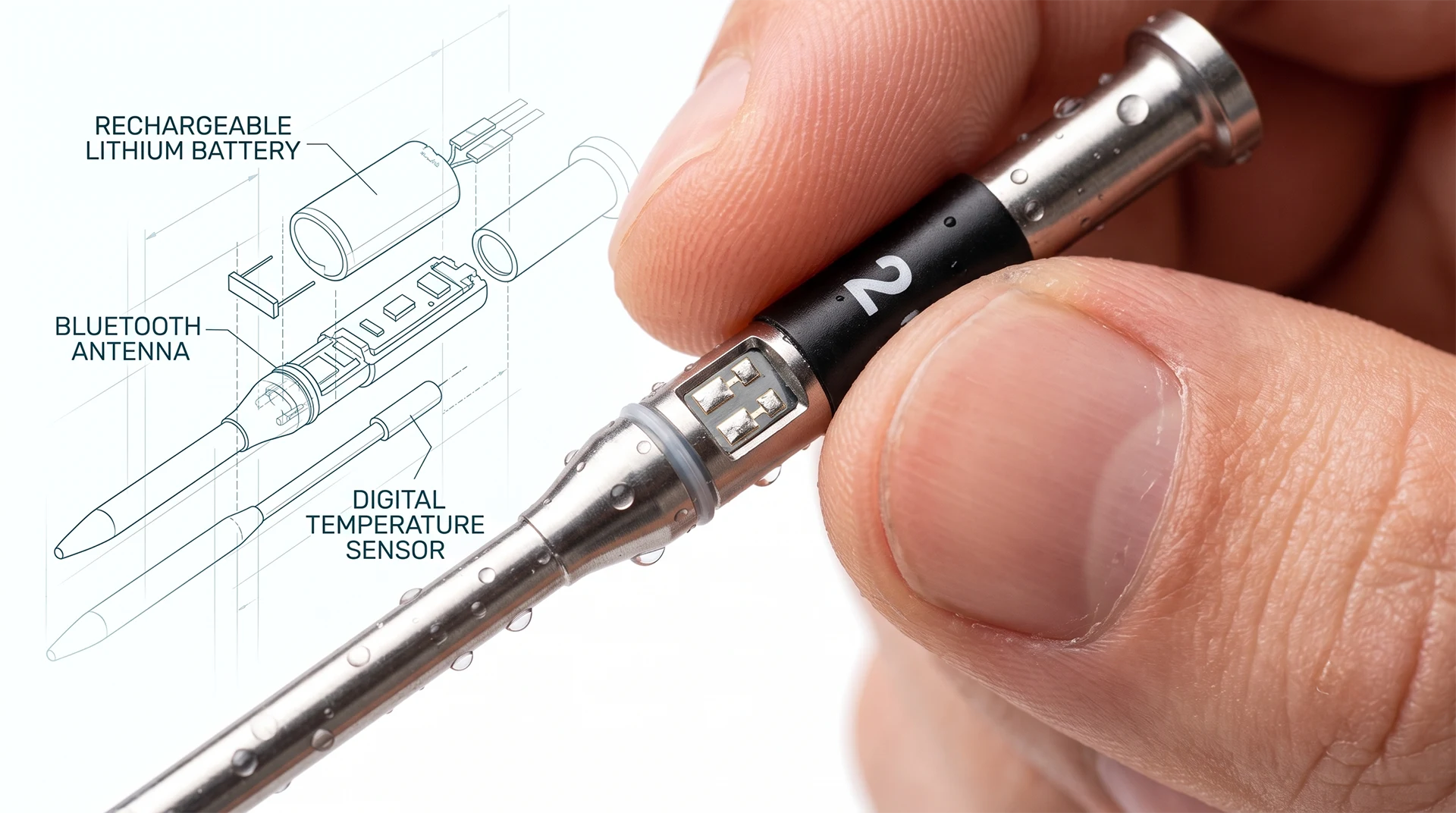
Comparison of True Wireless Probe with Wired Probe in conjunction with a Wireless Hub
This is the key thing to get — and the one most product listings intentionally obfuscate.
True wireless probes (ThermoMaven M1, Typhur Sync Gold, ThermoMaven S1, and Inkbird INT-14BW probe) house the sensor, a battery, and a transmitter in a single body. You bury the probe in the meat, close the lid, and nothing connects to anything on the outside. The probe sends the signal itself. They cost more and are ideal for rotisserie, smoker, and closed-grill cooking, where wires are irritating.
Traditional wired probes connect via heat-resistant cables to a small transmitter box (typically located outside your grill), like the system from Govee. That device then sends the information to your phone or receiver wirelessly. They are less expensive, allow multiple probes to run at the same time, and can be swapped out more easily if a probe dies — but you still have wires that can fray, pinch, or tangle.
⚠️ Stuff to Watch Out For:
“WiFi” on the Box When It’s Really Just Bluetooth: Some listings show “WiFi” in the title, but the fine print says it is Bluetooth only. Unlike WiFi thermometers that let you check temperatures from your couch, real ones allow you to use the internet to check temperature from anywhere.
Overbuying range you will never need: If your grill is only 20 ft from your back door, you don’t need a rocket-launcher radio system capable of communicating with the International Space Station.
Separate Screen vs. Phone-Only
You can get cheaper, all-phone, all-the-time thermometers (Govee, ThermoMaven S1) that give you way better data—graphs, cook history, recipe tips. But they also mean your phone battery is part of your cooking, and setup and fumbling with a touchscreen with greasy hands gets old pretty quickly during long cooks.
Systems with their own screen (ThermoMaven M1 booster, Typhur Sync Gold base, Inkbird receiver) offer a dedicated display and real buttons. Text messages, phone calls, and crashing apps will not be on your mind. Many still include a phone connection to back you up if you want both.
Durability and Waterproofing
Wireless probes have a hard life. They are stabbed into cold meat, cooked to more than 200°F inside, pulled out with greasy hands, and thrown into sinks. Of course, the need for any waterproofness is going to depend on your environment — some people don’t need it at all, while others want rugged gear with IP66 (RAIN + SPLASH SOAKING) or even IP67 (FULL UNDERWATER IMMERSION). Yes, if your fried turkeys are brined in buckets, the very least you should tolerate is IP67.
How I Tested These Thermometers
I do not evaluate cooking gear on a sterile laboratory bench. I test it as you will: in the midst of an actual cook, under time pressure, with flour on my hands and at dusk.
Test location: My backyard cook station in Austin, Texas, temps from 45°F (early mornings) to 104°F (afternoon sun). The grills used included a Weber Summit Kamado, an Oklahoma Joe Highland offset smoker, a Weber Spirit gas grill, and an inexpensive barrel smoker that leaks smoke from 20 different places.
VALIDITY TESTING: Each probe was subjected to an ice-water (32° F) bath and a boiling-water test (corrected for my elevation), compared with a calibrated Thermapen reference instrument. Prospects that were more than 2°F off were hit the road.
Range testing: I tested real-world Bluetooth and radio range through typical home construction (drywall, wood studs, brick exterior) ranging from 10 to 300 feet. When we say “stayed connected,” we mean the temperature updates never dropped out for more than 60 seconds.
Toughness test: Dropped onto concrete from 4 feet (for this, we were both intentional and unintentional), dipped in scalding hot water at 180°F to simulate a violent cleaning session, and left to bake for 14-plus hours on high heat in a smoker. We scrapped any probes that came up short on any of these.
Frequently Asked Questions
 Representative illustration
So, Which Of These Two Should You Buy?: The BOTTOM LINE
 Representative illustration
When it comes down to the right pick, two months of cooking, testing, and breaking things with your bare hands led us to one conclusion: What actually matters—not what the spec sheet has on bragging.
For people who want a versatile thermometer that does everything well and doesn’t break the bank: Buy the ThermoMaven M1. Individual display, dual probe, IP67 classification, 40-hour battery. It has survived every test I ran, and the booster display changed how I approach overnight cooks. My gift to the world this year is this one!
Check out the ThermoMaven M1 on Amazon now→